
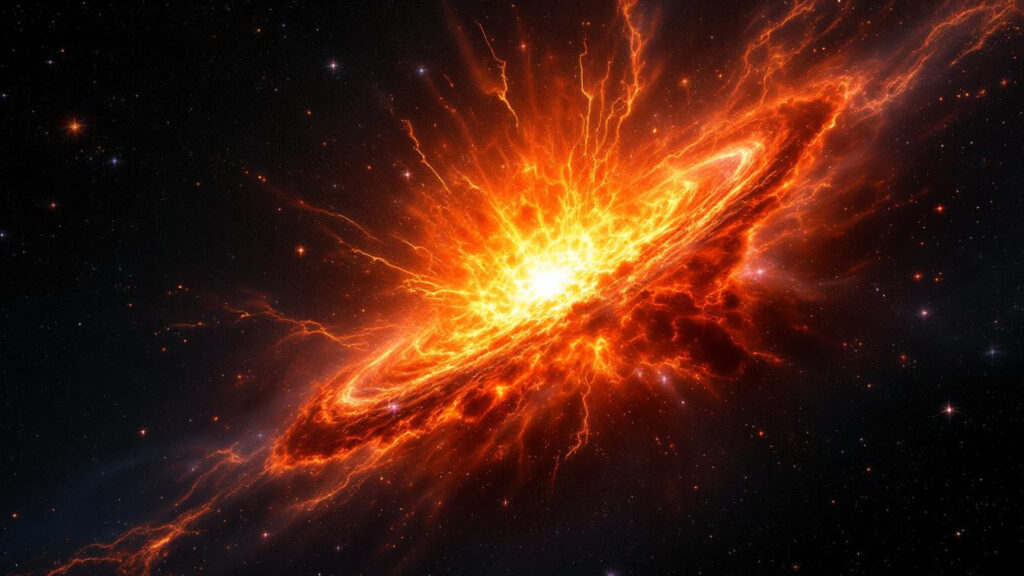

A recent discovery has astronomers buzzing with excitement as they captured an incredible moment in cosmic history: the explosion of a star at the farthest edges of the universe. This stellar explosion, designated SN in GRB 250314A, not only provides a glimpse into the early universe when it was merely 730 million years old but also reshapes our understanding of supernovae. Utilizing the advanced capabilities of the James Webb Space Telescope (JWST), researchers were able to isolate the faint light of this distant supernova from the surrounding galaxy, revealing details that were previously beyond reach.
Such observations are groundbreaking since most supernovae studied have occurred relatively close to Earth. This rare cosmic event opens a window to understanding the types of stars that existed and how they contributed to the universe’s evolution. The electromagnetic radiation emitted during this explosion resembled that of more recent supernovae, challenging previous assumptions about the brightness and color of early stellar explosions. Astronomers are now eager to delve deeper into these mysterious processes to better understand the formation and life cycles of stars in deep space.
Discovering the Most Distant Supernova
The recent observations from the JWST mark a significant milestone in space observation. By analyzing SN in GRB 250314A, astronomers are piecing together clues about the universe’s infancy. The combination of gamma-ray bursts identified in March with the JWST’s infrared imaging offers a comprehensive look at an extraordinary moment in time.
Key Findings from the Observation
- Distant Location: SN in GRB 250314A is the most distant supernova ever detected, situated billions of light years away.
- Age Insights: Reveals conditions of the universe when it was only 730 million years old, a crucial period for star formation.
- Stellar Composition: Electromagnetic emissions were unexpectedly similar to more local supernovae, offering new insights into early star characteristics.
- Future Research Directions: These findings set the stage for further exploration of stellar phenomena and their implications on cosmic evolution.
The Journey of Cosmic Exploration
As astronomers continue to unlock the secrets of our universe, each celestial discovery builds on the next. The JWST’s capabilities allow scientists to delve deeper into the cosmos than ever before, providing a clearer understanding of how the earliest stars contributed to the conditions we observe today. The implications of this research extend beyond mere observation; they challenge and refine the theories that underpin modern astrophysics.
The Significance of Stellar Explosions
Star explosions play a crucial role in the cosmic landscape. They not only serve as an end to a star’s lifecycle but also as catalysts for new formations. Elements forged in these explosive events become building blocks for subsequent stars, planets, and potentially life itself. Understanding these processes is vital for comprehending the universe’s evolution.
The Future of Astronomy
With findings from the JWST shedding light on distant cosmic events, astronomers are eager to expand their toolset further. Upcoming missions and advanced observational technologies promise to provide even more profound insights into the universe’s mysterious nature. As research continues, each discovery paves the way for new theories, enriching our collective understanding of the cosmos and our place within it.